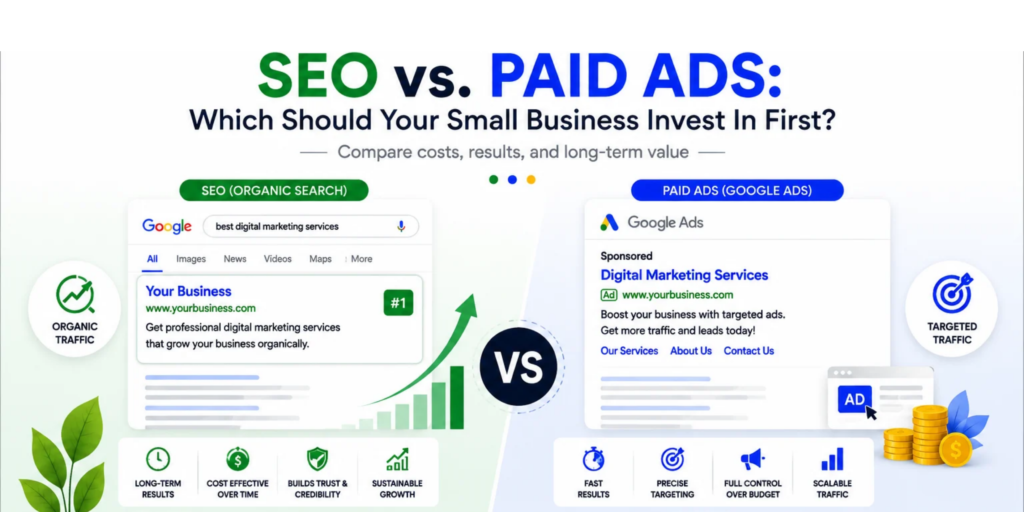
SEO vs. Paid Ads: Which Should Your Small Business Invest In First?
Should your small business invest in SEO or paid advertising? Discover the key differences between SEO and paid ads, their costs, benefits, and when to use each strategy to grow your business online.
Introduction
For small businesses trying to grow online, one important question often comes up: Should I invest in SEO or paid advertising first?
Both strategies can help businesses attract potential customers, increase website traffic, and generate leads. However, they work in very different ways.
SEO (Search Engine Optimization) focuses on improving your website’s organic visibility in search engines, while paid advertising allows businesses to pay for immediate visibility through platforms such as Google Ads and social media advertising.
Choosing the right strategy depends on your budget, goals, competition, and how quickly you need results.
In this guide, we’ll compare SEO and paid ads to help you understand which strategy may be the better starting point for your small business.
What Is SEO?
SEO, or Search Engine Optimization, is the process of improving a website so that it can appear higher in organic search results.
SEO involves optimizing different parts of your website and online presence, including:
- Keyword research
- On-page SEO
- Technical SEO
- Content creation
- Internal linking
- Website performance
- Mobile optimization
- Local SEO
- Link building
Unlike paid advertising, businesses don’t pay search engines every time someone clicks on an organic result.
When properly planned and maintained, SEO can become a long-term source of website traffic, leads, and business growth.
What Are Paid Ads?
Paid advertising allows businesses to pay platforms to display advertisements to potential customers.
Common paid advertising platforms include:
- Google Ads
- Facebook Ads
- Instagram Ads
- LinkedIn Ads
- YouTube Ads
Paid ads can target users based on factors such as keywords, location, interests, demographics, and online behavior.
Businesses pay for visibility, and paid advertising can generate traffic much faster than SEO. However, businesses need to continue spending money to keep their campaigns running.
SEO vs Paid Ads: Quick Comparison
| Feature | SEO | Paid Ads |
|---|---|---|
| Traffic | Organic | Paid |
| Results | Slower | Faster |
| Long-Term Value | High | Depends on ongoing spending |
| Initial Investment | Time + Resources | Advertising Budget |
| Targeting | Search Intent | Highly Targeted |
| Traffic After Stopping Investment | Can Continue | Usually Stops |
| Best For | Long-Term Growth | Immediate Visibility |
| Cost Per Click | No Direct Cost | Paid Per Click/Action |
💡 Pro Tip
The best digital marketing strategy isn’t always about choosing SEO or paid ads. Many businesses can benefit from using paid advertising for immediate visibility while building SEO to create sustainable long-term traffic.
7 Key Differences Between SEO and Paid Ads
Choosing between SEO and paid advertising depends on your business goals, budget, competition, and how quickly you need results. Here are seven important differences to help you make the right decision.
1. Speed of Results
One of the biggest differences between SEO and paid advertising is how quickly you can see results.
SEO usually takes time because search engines need to discover, evaluate, and rank your website and content. Depending on competition and the quality of your SEO strategy, meaningful results can take several months.
Paid advertising can provide visibility much faster once your campaigns are approved and running.
Key Takeaway:
If you need immediate visibility and traffic, paid ads are usually faster. If you’re building long-term organic growth, SEO is the better investment.
2. Cost
SEO and paid advertising require different types of investment.
SEO requires investment in areas such as content, technical optimization, keyword research, website improvements, and ongoing strategy.
Paid advertising requires an ongoing advertising budget. The amount you spend can vary depending on your industry, competition, keywords, audience, and campaign goals.
If you’re also planning your website budget, read our How Much Does a Business Website Cost in India? (2026 Pricing Guide) to understand the typical costs involved.
Key Takeaway:
SEO requires time and ongoing optimization, while paid advertising requires continuous spending to maintain traffic.
3. Long-Term Value
SEO can create long-term digital assets for your business.
For example, a well-optimized service page or helpful blog post can continue attracting organic visitors even after it has been published.
Paid advertising works differently. When you stop your advertising campaigns, the paid traffic generated by those campaigns generally stops as well.
Key Takeaway:
SEO is generally better suited for businesses looking to build sustainable long-term traffic and online visibility.
4. Targeting and Control
Paid advertising gives businesses significant control over who sees their advertisements.
Depending on the advertising platform, businesses can target customers based on:
- Location
- Age
- Interests
- Search keywords
- Demographics
- Online behavior
SEO primarily focuses on matching your website and content with what people are searching for.
Key Takeaway:
Paid advertising provides greater control over targeting, while SEO focuses on attracting people through relevant organic searches.
5. Trust and Credibility
Organic search visibility can help businesses establish credibility over time.
When a business consistently appears in relevant search results and provides useful information, customers may become more familiar with the brand.
Paid advertisements can also increase brand awareness, but users can see that the placement is sponsored.
Key Takeaway:
SEO can help build long-term organic visibility and authority, while paid ads are useful for increasing immediate exposure.
6. Competition
Both SEO and paid advertising can be competitive.
Ranking for popular keywords through SEO can take considerable effort, especially when competing against established websites.
Paid advertising can provide immediate visibility, but competitive keywords can also have higher advertising costs.
Before choosing a strategy, businesses should research their competitors and understand how difficult it may be to compete for their target audience.
Key Takeaway:
Understanding your competition can help you determine whether SEO, paid ads, or a combination of both makes the most sense.
7. Measuring Results
Both SEO and paid advertising can be measured, but the metrics you monitor are different.
SEO performance can include:
- Organic traffic
- Keyword rankings
- Search impressions
- Click-through rate
- Leads
- Conversions
Paid advertising can include:
- Impressions
- Clicks
- Cost per click
- Conversion rate
- Cost per lead
- Return on ad spend
Key Takeaway:
Don’t focus only on traffic or clicks. Measuring leads, conversions, and revenue gives you a better understanding of your marketing performance.
When Should a Small Business Invest in SEO?
SEO can be a strong choice if your business wants to build long-term organic visibility.
SEO may be suitable for businesses that:
- Want sustainable long-term growth.
- Want to attract customers through Google searches.
- Have a limited advertising budget.
- Can consistently create useful content.
- Want to build online authority.
- Are willing to wait for long-term results.
- Operate in a competitive local market.
SEO is especially valuable when potential customers regularly search online for the products or services your business provides.
If you’re looking to improve your organic visibility, explore our SEO Services to see how we can help your business improve its search presence.
Key Takeaway:
SEO is best suited for businesses that want to build a long-term source of organic traffic and visibility.
When Should a Small Business Invest in Paid Ads?
Paid advertising can be useful when your business needs faster visibility and traffic.
Paid ads may be suitable for businesses that:
- Need immediate website traffic.
- Are launching a new product or service.
- Have a limited-time promotion.
- Want to test market demand.
- Have a dedicated advertising budget.
- Need precise audience targeting.
- Want to generate leads quickly.
Paid campaigns can also provide valuable insights into which keywords, audiences, and offers drive the most interest.
Key Takeaway:
Paid advertising can be an effective option when your business needs immediate visibility and has the budget to support ongoing campaigns.
Should You Use SEO and Paid Ads Together?
Many businesses assume they have to choose between SEO and paid advertising.
In reality, the two strategies can work together.
A business can use paid ads to generate immediate traffic while simultaneously investing in SEO to build organic visibility.
For example, paid advertising can help a business promote a new service while SEO builds rankings for relevant keywords over time.
This approach can create a more balanced digital marketing strategy by combining short-term results with long-term growth.
Key Takeaway:
Using SEO and paid advertising together can help businesses generate immediate visibility while building a sustainable source of organic traffic.
Key Takeaway:
Using SEO and paid advertising together can help businesses generate immediate visibility while building a sustainable source of organic traffic.
Common SEO and Paid Advertising Mistakes Small Businesses Make
Introduction
Even when businesses invest money into digital marketing, poor planning can prevent them from achieving meaningful results.
Avoid these common mistakes:
- Expecting SEO results within a few weeks.
- Stopping SEO before giving the strategy enough time.
- Running paid ads without conversion tracking.
- Focusing only on clicks instead of leads or sales.
- Choosing keywords without understanding search intent.
- Sending paid traffic to a poorly designed landing page.
- Targeting an audience that is too broad.
- Running ads without setting a clear budget.
- Ignoring website speed and mobile responsiveness.
- Failing to optimize campaigns based on performance.
- Using SEO and paid ads without a clear overall strategy.
Choosing the right marketing channel is only one part of online success. Your website, content, SEO, advertising, and overall digital marketing strategy should work together to achieve your business goals. If you’re deciding how to build your website, read our guide on WordPress vs Custom Website: Which Is Better for Your Business in 2026?
Frequently Asked Questions (FAQs)
1. Is SEO better than paid advertising?
Neither strategy is automatically better. SEO is generally better suited for long-term organic growth, while paid advertising can provide faster visibility and traffic.
2. Is SEO cheaper than paid ads?
SEO doesn’t require businesses to pay for every organic click, but it still requires investment in strategy, content, optimization, and ongoing work. Paid advertising requires a continuous advertising budget.
3. How long does SEO take to show results?
SEO commonly takes several months to show meaningful results, although the timeline depends on competition, website quality, content, authority, and the keywords being targeted.
4. How quickly can paid ads generate results?
Paid advertising can generate visibility and traffic soon after campaigns are approved and launched. However, profitable results depend on factors such as targeting, ad quality, landing pages, budget, and conversion rates.
5. Should a small business use SEO and paid ads together?
Yes. Combining both strategies can allow businesses to generate immediate visibility through paid advertising while building sustainable organic traffic through SEO.
6. Which should I invest in first: SEO or paid ads?
If you need immediate traffic and have an advertising budget, paid ads may be a useful starting point. If your goal is long-term organic growth, SEO may be the better foundation. Many businesses can benefit from using both strategies together.
Ready to Grow Your Business Online?
Choosing between SEO and paid advertising shouldn’t be based simply on which strategy sounds better.
Your decision should depend on your business goals, target audience, competition, budget, and timeline.
At IRL Growth, we help businesses improve their online visibility through SEO, website development, content marketing, and digital marketing strategies designed around their specific goals.
Whether you need to build long-term organic visibility, generate immediate traffic through paid campaigns, or create a strategy that combines both, we’re here to help.