SEO vs GEO: What Small Businesses in Hyderabad Need to Know in 2026
When it comes to SEO vs GEO, customer search behavior is changing. A customer looking for a business used to type a few keywords into Google, scan the results, and choose a website to visit.
That’s changing.
Today, someone might ask ChatGPT, Perplexity, Google AI features, or another AI search tool a question such as, “What’s the best digital marketing agency for a small business in Hyderabad?”
Instead of receiving a page of links, they may receive a direct answer containing businesses, explanations, recommendations, or sources.
That creates an important question for small businesses:
Is traditional SEO still enough, or should businesses also optimize for AI-powered search?
The answer is both.
SEO and Generative Engine Optimization (GEO) are not competing strategies — in the SEO vs GEO comparison, they address different parts of the same online discovery process.
For small businesses in Hyderabad, understanding SEO vs GEO can help you prepare for the way customers are increasingly finding information online.
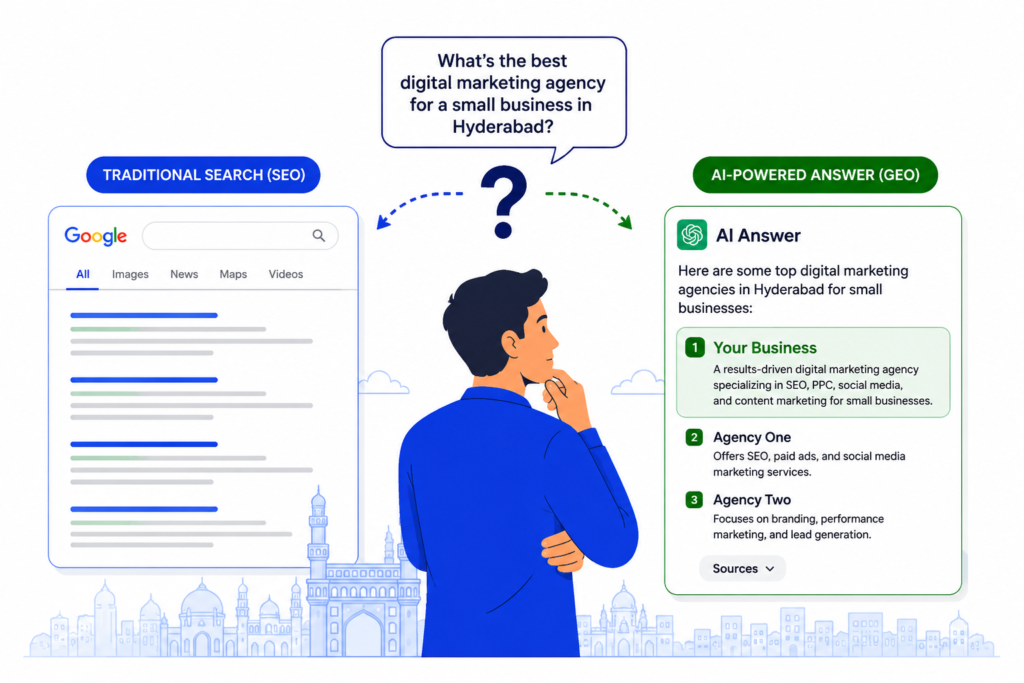
SEO vs GEO: What Is SEO?
Search Engine Optimization, or SEO, is the process of improving a website so search engines can understand, index, and rank its pages for relevant searches.
For a small business, SEO can include:
Creating useful website content
Targeting relevant search queries
Optimizing page titles and headings
Improving internal links
Improving website speed and technical performance
Building relevant backlinks and mentions
Improving local search visibility
Maintaining accurate business information
For example, a digital marketing agency in Hyderabad might create a page targeting searches such as “digital marketing agency in Hyderabad” or “SEO services for small businesses in Hyderabad.”
The objective is straightforward: make the website useful and relevant enough to appear when potential customers search for those services.
SEO remains an important part of digital marketing and is not disappearing because of AI search.
SEO vs GEO: What Is GEO?
Generative Engine Optimization, commonly called GEO, focuses on improving how a business and its content can be understood and potentially referenced by generative AI systems.
Instead of asking only:
“How do I rank higher on Google?”
businesses can also ask:
“If someone asks an AI about my service or industry, is there enough reliable information online for my business to be considered?”
For example, someone could ask:
“What are some good SEO agencies for small businesses in Hyderabad?”
An AI system may use information from websites, search indexes, business profiles, publications, and other online sources when generating an answer.
The goal of GEO isn’t to force an AI system to mention your company.
Instead, it is about building a clear and credible online presence that helps systems understand:
What your business does
Who you serve
Where you operate
What services you provide
What makes your business different
Whether your expertise is supported by other sources
That is the practical side of GEO.
SEO vs GEO: What's the Difference?
The simplest way to understand the difference is:
SEO focuses primarily on visibility in traditional search results, while GEO focuses on improving your chances of being understood, mentioned, or cited within AI-generated answers.
SEO generally aims to earn search visibility and clicks.
GEO aims to make your business and content useful and understandable within AI-powered discovery experiences.
However, there is significant overlap between the two.
Both benefit from:
Useful content
Clear website structure
Strong technical foundations
Relevant information
Authority and trust
Consistent business details
A good user experience
This is why GEO should generally be viewed as an extension of your existing search strategy rather than a completely separate marketing channel.
Is GEO Replacing SEO?
No.
This is one of the biggest misconceptions surrounding AI search.
A business should not abandon its SEO strategy simply because customers are beginning to use AI tools for information.
AI systems still need information from somewhere. Websites, search indexes, business profiles, publications, and other online sources can all contribute to the information available to users.
That means the fundamentals still matter.
A website with poor technical SEO, unclear services, weak content, inconsistent business information, and little evidence of expertise is unlikely to become competitive simply because it adds a few GEO-related phrases.
A better approach is:
Build strong SEO foundations → create useful content → establish authority → make your information clear and consistent → monitor AI visibility.
SEO gets your business into the wider search ecosystem.
GEO adds another layer by considering how your information may be used in AI-powered discovery.
Why Does GEO Matter for Small Businesses in Hyderabad?
Hyderabad has a large and highly digital customer base.
Businesses across areas such as Gachibowli, HITEC City, Madhapur, Banjara Hills, Jubilee Hills, Kondapur, and Secunderabad compete for customers through Google Search, Google Maps, social media, business directories, and other online channels.
Now, potential customers also have the option of asking conversational questions.
For example:
“Which web design company in Hyderabad is good for a small business?”
“Who provides SEO services near Gachibowli?”
“What is a good digital marketing agency for startups in Hyderabad?”
“Which branding company should I consider in Banjara Hills?”
These searches are different from simply typing a few keywords.
The customer is describing a problem and asking for a recommendation.
That means businesses need to communicate more than just their target keywords.
Your website should make it clear what you do, who you help, where you operate, and why someone should trust your business.
For smaller companies, this can create an opportunity because many local competitors have not yet started thinking seriously about AI-powered discovery.
How Can You Make Your Website More GEO-Friendly?
There is no magic GEO setting and no guaranteed formula for getting your business mentioned by an AI system.
However, there are several practical improvements that can make your website easier for both people and search systems to understand.
1. Answer Important Questions Clearly
Don’t make visitors read several paragraphs of marketing language before they understand what you actually offer.
Answer important customer questions directly.
For example:
What does your SEO service include?
Explain the actual services you provide.
How much does SEO cost?
Explain the factors that influence pricing.
How long does SEO take?
Explain that results depend on competition, website condition, industry, content, authority, and other factors.
Clear answers make your website more useful to customers and provide search systems with clearer information about your expertise.
2. Create Content Around Real Questions
One of the easiest ways to create useful content is to start with questions customers actually ask.
For a web design company in Hyderabad, those questions might include:
WordPress vs custom website: which is better?
How long does it take to build a business website?
Does a small business really need SEO?
How can I improve my website’s Google ranking?
How can my business appear in AI search results?
These questions can become blog posts, guides, FAQ sections, or sections within your service pages.
The important thing is not to create content simply because a keyword tool shows search volume.
Create content because the information is genuinely useful to your potential customers.
3. Be Specific
Generic content is easy to find.
Specific information is more useful.
Compare these two statements:
“We provide high-quality SEO services that help businesses grow online.”
with:
“We help small businesses improve organic visibility through technical SEO, service-page optimization, local SEO, content strategy, and ongoing performance analysis.”
The second statement provides much more information.
Where appropriate, include:
Specific locations
Services
Industries
Processes
Examples
Case studies
Original observations
Data
Frequently asked questions
Specificity gives customers a better understanding of your expertise.
4. Build Topic Authority
One article about SEO isn’t enough to demonstrate deep expertise.
A stronger strategy is to create a group of related articles that cover different parts of the same subject.
For example, an SEO content cluster could include:
Main topic:
SEO for Small Businesses
Supporting topics:
SEO vs GEO
Local SEO for Small Businesses
How Google Business Profile Helps Local Businesses
On-Page SEO Checklist
Technical SEO for WordPress Websites
How Long Does SEO Take?
SEO vs Paid Advertising
Common SEO Mistakes Small Businesses Make
These articles can link to one another and to your main SEO service page.
This creates a stronger information structure for visitors and gives your website greater topical depth.
5. Keep Your Business Information Consistent
Local businesses should pay particular attention to consistency.
Your business name, services, location, contact details, and other important information should be accurate across your website and major business profiles.
Review your:
Website
Google Business Profile
Business directories
Social media profiles
Industry listings
Review platforms
Other relevant business profiles
If important information differs from one platform to another, it can create confusion for potential customers and search systems.
A consistent digital presence is easier to understand and maintain.
6. Use Structured Data Where Appropriate
Structured data can help search engines understand the information and relationships represented on a webpage.
Depending on the type of website and page, relevant structured data may include:
Organization
LocalBusiness
Article
BreadcrumbList
Service
Product
FAQPage
However, structured data shouldn’t be treated as a shortcut to AI visibility.
It should accurately describe the information that is actually present on the page and follow applicable search-engine guidelines.
Good structured data supports good content.
It doesn’t replace it.
7. Don't Ignore Technical SEO
It’s easy to become focused on AI search and forget the basics.
Your website should still be:
Crawlable
Indexable
Mobile-friendly
Secure
Easy to navigate
Properly structured
Free from major technical problems
Important areas to review include:
XML sitemaps
Robots.txt
Canonical URLs
Internal links
Mobile usability
Core Web Vitals
Broken links
Indexing issues
Page experience
GEO should complement technical SEO rather than replace it.
8. Build Your Online Presence Beyond Your Website
Your website is only one part of your online presence.
Depending on your industry, relevant mentions can come from:
Local business directories
Industry websites
Professional organizations
Local publications
Partner websites
Interviews
Business profiles
Genuine customer reviews
The goal isn’t to create hundreds of low-quality listings.
The goal is to build a credible digital footprint using relevant and trustworthy sources.
9. Create Content Worth Referencing
Perhaps the most important question to ask when creating GEO-focused content is:
“Why would someone choose this content over the hundreds of other pages covering the same topic?”
Repeating a keyword isn’t a good answer.
A strong content marketing strategy can use original research, first-hand experience, useful examples, case studies, and expert analysis to create content that provides genuine value.
For example, instead of writing another generic article about website speed, a web agency could analyze a group of local business websites and explain the most common performance problems it found.
That creates something more distinctive than a generic definition of page speed.
10. Can You Actually Get Cited by ChatGPT?
There is no guaranteed method for getting a business cited by ChatGPT.
You cannot simply add “ChatGPT” as a keyword and expect your company to appear.
You also shouldn’t believe claims that a particular GEO trick can guarantee a position in AI-generated answers.
Instead, focus on building a strong online presence.
Make your business information:
Accurate
Consistent
Specific
Useful
Relevant
Supported by credible sources
Then monitor how your business appears when potential customers ask relevant questions.
That is a much more sustainable approach than trying to find a single GEO hack.
How to Check Your AI Search Visibility
You don’t necessarily need expensive software to start monitoring your AI visibility.
Begin by creating a list of questions that your customers could realistically ask.
For example, a web design company in Hyderabad could test questions such as:
“Best web design companies for small businesses in Hyderabad?”
“Who builds affordable business websites in Hyderabad?”
“What should a Hyderabad startup look for in a web development agency?”
“Best website development agencies near Gachibowli?”
Run similar questions through the AI search tools your potential customers may use.
Track:
Whether your business appears
Which competitors appear
Which sources are mentioned
Whether your website is cited
What information the AI associates with your business
How the results change over time
Repeat the process regularly.
The objective isn’t to obsess over a single answer.
You’re looking for patterns.
What Should a Small Business Focus on First?
If your website currently has technical problems, weak service pages, little useful content, poor local visibility, or inconsistent business information, start with the fundamentals.
A practical order is:
Step 1: Fix Technical SEO
Make sure search engines can crawl, understand, and index your website.
Step 2: Improve Your Service Pages
Clearly explain what you offer, who you serve, and where you operate.
Step 3: Strengthen Local SEO
Keep your local business information accurate and consistent.
Step 4: Publish Useful Content
Answer real customer questions instead of producing generic keyword-focused articles.
Step 5: Build Authority
Work toward relevant mentions, links, reviews, partnerships, and other credible references.
Step 6: Monitor AI Visibility
Once the foundation is in place, start tracking how your business appears in relevant AI-powered searches.
This approach is more sustainable than trying to “hack” AI search.
Common GEO Mistakes Small Businesses Should Avoid
Mistake 1: Replacing SEO With GEO
GEO doesn’t mean you should stop optimizing your website for traditional search.
SEO remains an important part of your online visibility.
Mistake 2: Stuffing AI-Related Keywords
Adding phrases such as “ChatGPT SEO” or “GEO optimization” repeatedly won’t automatically make your business appear in AI answers.
Write for your customers first.
Mistake 3: Publishing Generic AI-Generated Content
AI tools can help with research, brainstorming, editing, and organization.
But publishing large quantities of generic content without original insight or quality control isn’t a strong long-term strategy.
Mistake 4: Making Unsupported Claims
Don’t invent statistics, customer results, case studies, or industry data simply to make an article sound more authoritative.
Trust is more valuable than impressive-sounding numbers.
Mistake 5: Ignoring Local SEO
If your business serves Hyderabad, make that clear.
Explain your service areas naturally and keep your local business information accurate.
Mistake 6: Expecting Instant Results
SEO takes time, and AI visibility can change.
An AI system mentioning your business once doesn’t mean you have permanently “ranked” in AI search.
Treat GEO as an ongoing visibility strategy rather than a one-time optimization task.
SEO vs GEO: Which One Is More Important?
For most small businesses, the answer isn’t SEO or GEO.
It’s SEO first, with GEO alongside it.
SEO helps establish the technical, content, authority, and local foundations your business needs to be discoverable online.
GEO adds another consideration: whether your business information is clear, useful, and credible enough to be included in AI-powered discovery experiences.
The businesses preparing for both aren’t choosing between two unrelated marketing strategies.
They’re preparing for the way search is evolving.
Frequently Asked Questions (FAQs)
1. Is GEO better than SEO?
No. GEO and SEO have different focuses. SEO is primarily concerned with visibility in traditional search, while GEO focuses on improving how a business and its content may be understood and surfaced in generative AI experiences.
2. Does GEO replace traditional SEO?
No. GEO should generally complement SEO rather than replace it. Technical SEO, useful content, website quality, authority, and local search visibility remain important.
3. How can a small business appear in ChatGPT results?
There is no guaranteed method for getting a business mentioned by ChatGPT. A practical approach is to build accurate, useful, authoritative, and consistent information across your website and other credible online sources, then monitor relevant AI-generated answers.
4.Is GEO important for local businesses?
It can be. Customers increasingly use conversational searches to ask about products, services, and local businesses. Making your services, location, expertise, and business information clear can help create a stronger online presence.
5. Should small businesses invest in GEO in 2026?
If your SEO fundamentals are already in good shape, improving your AI-search visibility is worth exploring. Start with content quality, local SEO, technical accessibility, structured information, and authority rather than promises of guaranteed AI rankings.
6. How often should I check my AI visibility?
A monthly check is a reasonable starting point. Use a consistent group of customer-focused questions and track whether your business, competitors, and relevant sources appear in the answers over time.
Final Thoughts
The way people discover businesses is changing.
Traditional Google searches aren’t disappearing, but customers now have another way to find information: they can ask an AI system to research a problem and provide an answer.
For a small business in Hyderabad, that creates both a challenge and an opportunity.
You don’t need to abandon SEO.
You don’t need to chase every new GEO tactic.
And you don’t need to believe anyone promising guaranteed ChatGPT rankings.
Instead, build the fundamentals:
A technically strong website.
Useful and specific content.
Clear service information.
Strong local visibility.
Consistent business details.
Relevant authority and mentions.
Content that genuinely answers customer questions.
Then start paying attention to how your business appears in AI-powered search.
The businesses that start building this foundation now will be better prepared as search continues moving from “here are ten links” toward “here’s the answer.”
If you’re unsure whether your website is ready for both traditional search and AI-powered discovery, IRL Growth’s SEO Services can help you identify the technical, content, local SEO, and visibility improvements your business needs.
Getting SEO vs GEO right today means your business shows up whether customers search on Google or ask an AI assistant.